Senin, 21 Oktober 2019

DEFINISI ANALISIS JABATAN

1.        Job Analysis
Job Analysis ini adalah sebuah proses untuk mengidentifikasikan dan menentukan secara rinci tugas dan persyaratan pekerjaan tertentu serta kepentingan yang berkaitan dengan tugas-tugas pada jabatan atau pekerjaan tertentu.
Tujuan
a.    Rekrutmen dan Seleksi  : Analisis Jabatan membantu manajemen untuk menentukan jenis orang yang dibutuhkan untuk mengisi jabatan atau melakukan pekerjaan tertentu.
b.    Menilai Kinerja Karyawan : Dengan Analisis Jabatan atau Job Analysis (Analisis Pekerjaan) ini, manajemen dapat memeriksa apakah sasaran dan tujuan pekerjaan yang dibebankan ke karyawan yang bersangkutan sudah tercapai atau tidak.
c.     Pelatihan dan Pengembangan : Analisis Jabatan atau Analisis Pekerjaan ini juga dapat digunakan untuk menilai kebutuhan pelatihan dan pengembangan karyawan.
d.    Manajemen Kompensasi : Job analysis atau analisis pekerjaan ini memainkan peranan yang penting dalam menentukan paket gaji, tunjangan dan insentif karyawan.
Manfaat
a.    Menetapkan dasar rasional penggajian ataupun pengupahan yang lebih objektif.
b.    Menghapuskan persyaratan kerja yang dapat menyebabkan diskriminasi karyawan.
c.    Merencanakan kebutuhan sumber daya manusia di waktu yang akan datang sebagai proses perencanaan
d.    Menentukanlamaran dengan  lowongan pekerjaan yang tersedia.
e.    Menentukan dasar dan kebutuhan diselenggarakannya latihan untuk karyawan baru maupun lama.
f.     Menentukan pola sistem pengembangan karir karyawan yang tepat dan menyeluruh
g.    Memperbaiki alur kerja
h.    Penataan jabatan dan pengembangan organisasi.

2.        Human Resources Planning
perencanaan yang membantu perusahaan untuk merekrut, memelihara, dan mengoptimalisasi penugasan orang-orang yang dibutuhkan untuk mencapai tujuan tujuan bisnis. Selain itu, dengan melakukan perencanaan ini, para pegawai juga dapat menyikapi berbagai perubahan pada lingkungan luar (perusahaan).
Pentingnya Human Resources Planning
a.    Analisis tujuan
b.    Inventaris sumber daya manusia terkini
c.    Prediksi kebutuhan dimasa yang akan dating
d.    Estimasi adanya gap
e.    Formulasikan rencana
f.     Penerapan rencana
g.    Monitor, Kontrol, dan feedback

3.        Job Description
Job description adalah uraian yang menggambarkan bagaimana pekerjaan atau jabatan seseorang yang menjalani, bagaimana wewenangnya, tanggung jawab yang harus dilaksanakan, hubungannya dengan jabatan atau pekerjaan lain dan resiko jabatan atau resiko dari pekerjaan tersebut.
Meliputi
a.    Identifikasi jabatan
b.    Rincian tugas yang harus dilaksanakan
c.    Kondisi sekitar lingkungan kerja
d.    Bahan, alat maupun mesin yang dipergunakan
e.    Ringkasan jabatan

4.        Job Specification
Job Specification adalah uraian tentang persayaratan yang harus dimiliki atau yng diperlukan untuk seseorang yang akan melaksanakan pekerjaan atau menerima pekerjaan tersebut.

Meliputi
a.    Identifikasi jabatan seperti Nama, Kode, Bagian
b.    Persyaratan jabatan seperti riwayat pendidikan, pengalaman yang diperlukan, syarat fisik, jenis kelamin, usia, kewarganegaraan, status kemampuan dsb.

5.        Job Design
Job Design (desain pekerjaan) adalah suatu alat untuk memotivasi dan memberi tantangan pada karyawan. Oleh karena itu perusahaan perlu memiliki suatu sistem kerja yang dapat menunjang tercapainya tujuan perusahaan secara efektif dan efisien yang dapat merangsang karyawan untuk bekerja secara produktif, mengurangi timbulnya rasa bosan dan dapat meningkatkan kepuasan kerja, desain pekerjaan terkadang digunakan untuk menghadapi stress kerja yang dihadapi karyawan (Sulipan, 2000)
Tujuan
Menurut (Sunarto, 2005) desain pekerjaan memiliki tujuan agar :
a.    Efisiensi operasional, produktifitas dan kualitas pelayanan menjadi optimal.
b.    Fleksibilitas dan kemampuan melaksanakan proses kerja secara horizontal dan hirarki.
c.    Minat, tantangan, dan prestasi menjadi optimal.
d.    Tanggung jawab tim ditetapkan sedemikian rupa, sehingga bisa meningkatkan kerja sama dan efektifitas tim.
e.    Integrasi kebutuhan individu karyawan dengan kebutuhan organisasi

Sumber :

https://kristinmoniy.blogspot.com/2019/10/manajemen-sumber-daya-manusia-tugas-2.html?m=1
https://ilmumanajemenindustri.com/pengertian-analisis-jabatan-job-analysis-tujuan-analisis-jabatan/

Senin, 30 September 2019

MANAJEMEN SUMBER DAYA MANUSIA

Pengertian Manajemen Sumber Daya Manusia

Manajemen sumber daya manusia adalah suatu proses yang terdiri atas perencanaan, pengorganisasian, pemimpin dan pengendalian kegiatan-kegiatan yang berkaitan dengan analisis pekerjaan, evaluasi pekerjaan, pengadaan, pengembangan, kompensasi, promosi dan pemutusan hubungan kerja guna mencapai tujuan yang ditetapkan.

Manajemen sumber daya manusia mengatur dan menetapkan program kepegawaian yang mencakup masalah-masalah sebagai berikut :

1. Menetapkan jumlah, kualitas dan penempatan tenaga kerja yang efektif sesuai dengan kebutuhan perusahaan berdasarkan job description (pembagian tugas dan tanggung jawab), job specification (spesifikasi pekerjaan), job reqruitment (syarat pekerjaan) dan job evaluation (evaluasi pekerjaan).

2. Menetapkan penarikan, seleksi dan penempatan karyawan berdasarkan ada the right man in the right place and the right man in the right job (menempatkan karyawan pada tempat dan kedudukan yang tepat).

3. Menetapkan program kesejahteraan, pengembangan, promosi dan pemberhentian.

4. Meramalkan penawaran dan permintaan sumber daya manusia pada masa yang akan datang.

5. Memperkirakan keadaan perekonomian pada umumnya dan perkembangan peprusahaan pada khususnya.

6. Memonitor dengan cermat undang-undang perburuhan dan kebijaksanaan pemberian balas jasa perusahaan-perusahaan sejenis.
hak
7. Memonitor kemajuan teknik dan perkembangan serikat buruh.

8. Melaksanakan pendidikan, latihan dan penilaian produktivitas karyawan.

9. Mengatur mutas karyawan baik vertikal maupun horizontal.

10. Mengatur pensiun, pemberhentian dan pesangonnya.

Tujuan utama manajemen sumber daya manusia adalah untuk meningkatkan kontribusi pegawai terhadap organisasi dalam rangka mencapai produktivitas organisasi yang bersangkutan. Hal ini dapat dipahami karena semua kegiatan organisasi dalam mencapai tujuan tergantung kepada manusia yang mengelola organisasi yang bersangkutan. Oleh sebab itu, sumber daya manusia tersebut harus dikalola agar dapat berdaya guna dan berhasil guna dalam mencapai tujuan organisasi.

Fungsi Manajemen Sumber Daya Manusia

a. Staffing/Employment
Fungsi ini terdiri dari tiga aktivitas penting, yaitu perencanaan, penarikan dan seleksi sumber daya manusia. Sebenarnya para manajer bertanggung jawab untuk mengantisipasi kebutuhan sumber daya manusia. Dengan semakin berkembangnya perusahaa, para manajer menjadi lebih tergantung pada departemen sumber daya manusia untuk mengumpulkan informasi mengenai komposisi dan keterampilan tenaga kerja saat ini.

b. Performance Evaluation
Departemen sumber daya manusia dan para manajer. Para manajer menanggung tanggung jawab utama untuk mengevaluasi bawahannya dan departemen sumber daya manusia bertanggung jawab untuk mengembangkan bentuk penilaian kinerja yang efektif dan memastikan bahwa penilaian kinerja tersebut dilakukan oleh seluruh bagian perusahaan.

c. Compensation
Dalam hal kompensasi atau reward dibutuhkan suatu koordinasi yang baik antara departemen sumber daya manusia dengan para manajer. Para manajer bertanggung jawab dalam hal kenaikan gaji, sedangkan departemen sumber daya manusia bertanggugn jawab untuk mengembangkan struktur gaji yang baik.

d. Training and Development
Departemen sumber daya manusia bertanggung jawab untuk membantu para manajer menjadi pelatih dan penasehat yang baik bagi bawahannya, menciptakan program pelatihan dan pengembangan yang efektif baik bagi karyawan baru maupun yang sudah ada, terlibat dalam program pelatihan dan pengembangan tersebut, memperkirakan kebutuhan perusahaan akan program pelatihan dan pengembangan, serta mengevaluasi efektivfitas program pelatihan dan pengembangan. Tanggung jawab departemen sumber daya manusia dalam hal ini juga menyangkut masalah pemutusan hubungan kerja tanggung jawab ini membantu restrukturisasi perusahaan dan memberikan solusi terhadap konflik yang terjadi dalam perusahaan.

e. Employee Relation
Dalam perusahaan yang memiliki serikat pekerja, departemen sumber daya manusia berperan aktif dalam melakukan negosiasi dan mengurus masalah persetujuan dengan pihak serikat pekerja. Membantu perusahaan menghadapi serikat pekerja merupakan tanggung jawab departemen sumber daya manusia. Setelah ersetujuan disepakati, departemen sumber daya manusia membantu para manajer tentang bagaimana mengurus persetujuan tersebut dan menghindari keluhan yang lebih banyak.

f. Safety and Health
Setiap perusahaan wajib untuk memiliki dan melaksanakan program keselamatan untuk mengurangi kejadian yang tidak diinginkan dan menciptakan kondisi yang sehat. Tenaga kerja perlu diingatkan secara terus menerus tentang pentingnya keselamatan kerja suatu program keselamatan kerja yang efektif dapat mengurangi jumlah kecelakaan dan meningkatkan kesehatan tenaga kerja secara umum. Departemen sumber daya manusia mempunyai tanggung jawab utama untuk mengadakan pelatihan tentang keselamatan kerja, mengidentifikasi dan memperbaiki kondisi yang membahayakan tenaga kerja dan melaporkan adanya kecelakaan kerja.

g. Personal Research
Dalam usahanya untuk meningkatkan efektifitas perusahaan, departemen sumber daya manusia melakukan analisis terhadap masalah individu dan perusahaan serta membuat perubahan yang sesuai. Masalah yang sering diperhatikan oleh departemen sumber daya manusia adalah penyebab terjadinya ketidakhadiran dan keterlambatan karyawan, bagaimana prosedur penarikan dan seleksi yang baik dan penyebab ketidakpuasan tenaga kerja. Departemen sumber daya manusia bertanggugnjawab untuk mengumpulkan dan menganalisis informasi yangn menyinggung masalah ini. Hasilnya digunakan menilai apakah kebijakan yang sudag ada perlu diadakan perubahan atau tidak.


Sumber

Senin, 26 November 2018

COMPLAINT LETTER & APPLICATION LETTER

COMPLAINT LETTER
A complaint letter is a type of letter written to address any type wrong doing, offence, grievance, resentment arising out of a product, service etc. Complaint letter are used to raise your concerns about unfair things and seek a productive outcome. they are also used to vent out your pent up emotions arising out of your suffering or bad experience. It is a fundamental right and duty of a citizen to seek justice arising out of any injustice, which is initiated by a complaint. Complaint letters then, become your first step towards your consumers right. They inspire other hassled consumers, influence the concerned authorities towards taking proper action and make the defaulters more liable, respomsible and responsive. This is because unresponsive behaviour of the offender is liabble to a punishable court proceeding or an expensive lawsuit.
writing complaints letters is an essential responsibility of the victim whilst seeking positive outcomes. Complaint letter writing is not only a pre-warning for the offender but also a chance for them to rectify their act in time. These letters are not just meant for defective products, service, they can also be written towards any injustice happem-ning in the society, like "smoking in public", "misuse of water by any person or an organization" and any issue happening in society which needs to be addressed. Anyone can complait through letter if there is a legitimate reason. Anyone can write a letter to the administration regarding the pollution, water supply, traffic prooblems, shortage of electricity tec. You don't need to be a lawyer or an influential person. All you need to do is to learn to write a complaint letter in a appropriate manner with all the relevant information included. IIn the matter contained here, you will get all the tips to write a complaint letter.

HOW TO WRITE A COMPLAINT LETTER TO A COMPANY
1. Address your letter to the customer service department.
When writing a letter of complaint, your best chance of success will come from directing the letter to the customer service department of the company. The customer service department is accustomed to dealing with complaints and your letter is likely to be processed efficiently and effectively.

2. Quickly get to the point of your letter.
The very firts line of your letter should clearly address why you  are writeng the letter and what your exact complaint is. Give as many pertinent facts as possible, including the date, time and location where you made the purchase or received the service, along with any relevant serial or model numbers.

3. State specifically what outcome or remedy will satisfy you.
If you want a replacement, a refund, a repair, or some other form of compensation, state this clearly in your second paragraph. This will help to avoid receiving a form letter or other stock response, and give the recipients something tto work with on their end.

4. Attach copies of suporting documents.
These may include receipts, guarantees, warranties, copies of checks you send and if appropriate, photos or videos. All documentation should be include with your letter.

5. Give them a time to resolve the matter.
It is helpful to provide an exact time period within which you would like the isuue to be resolved. This will give you ppeace of mind and will help bring the issue to a speedy conclusion.

6. Finish the letter respectfully.
Thank the recipient for their assistance, and llet them know how and when they can reach you to resolve the matter. This will make their job a lot easier, resulting in a more efficient outcome for you.

Example :

APPLICATION LETTER
An application letter is merely another name for a cover letter, the official business letter often included with a job application and/or resume and sent to a prospective employer. Although application letters are generally considered optional components of applying for a jb, more and more frewuently, employers are singling out those who actually take the time to write anapplication letter as their top picks. Here are a few components of a typiical, successful application letter :
Professional style
Application letters usually and sholud always be in an officer letter style, like block style. These letters should be formatted properly and checked for spelling and grammatical errors.

Salutation
Although many application letters open with a simple "Sir or Madam", the more successful application letters ate addressed personally to the hiring manager (which ooften takes some research on the part of the job applicant).

Body
The body of a good application letter usually 3 to 4 paragraph, explains why the applicant is a good fit for the job, explains relevant experience and shows how that experience would be useful if selected for the carrer opportunity.

Attachments
An application letter is rarely sent to a prospective employer alone. It is usually accompanied by a resume, salary history, list of references, and/or other documentation of achievements.

Length
Application letters are generally no more  than one page in length. Employers are unimpressed by application letters of half a page or less, though fillingg most of one page is the safest way to complete an application letter.

Example :


QUESTION

COMPLAINT LETTER
1. Who wrote the complaint letter ?
     Samantha Brown
2. What is Samantha complaining about?
     The holiday that agency arranged for her and her family
3. On what date Samantha write the complaint letter?
     16th November
4. What mistakes the agaency made?
     The agency spelt Samantha name wrong on the booking form
5. What Samantha want?
     Agency to refund the money that she paid for her holiday

APPLICATION LETTER
1. Who sent the application letter?
     Christina Black
2. To whom is the letter intended?
     Mary Cody
3. Where did the aplication letter come from?
     987 Maple Avenue, Bussiness City, New York
4. What is the position Christina want?
     Front Office Assistant
5. What is Mary Cody position?
     Hiring manager


Reference :


Senin, 12 November 2018

INQUIRY LETTER AND ORDER LETTER

1. inquiry letter
A letter of request, also known as a letter or letters of interesting candidates, will be sent to the companies. Letter of request is a letter from a prospective buyer to the seller requesting information about the products offered. With the offer of the seller will potential buyers will know the price, and the sale and purchase, and a description of the goods or services to be purchased. This is the purpose of the prospective buyer a written request to the seller.
When a prospective buyer has to know the condition of the goods / services following the price and terms of sale and purchase, of course he did not need to ask for a quote from the seller. Letter of inquiry required in formal trade demand formal procedures in writing. Letter of inquiry is often an early stage of the business transactions. Through a letter of inquiry to ask a potential buyer or to request information about the goods or services to be purchased. In reaction, the seller explained the things he wanted to know the buyer, the buyer did finally order and business transactions as the top buying and selling process.
In the letter of demand for the goods usually offer prospective buyers ask:
1.    name and type of goods;
2.    special characteristics (specifications) of goods, namely, the type, size, quality, capacity and others;
3.    unit price.
4.    Pieces;
5.    method of payment;
6.    means of delivery, and
7.    ease that may be obtained by the buyer, such as guarantees and other


2. order letter
An order letter, also known as a purchase order or PO, begins the paper trail of a specific purchase. The objective is to provide the vendor with detailed instructions for fulfilling an order. It also serves as a legal record of the transaction and, consequently, should be written with care.
Your intentions need to be clear and concise. Attention to detail is crucial. The reader will fill your order only according to your instructions; your satisfaction will depend largely upon their accuracy.
The scope should include only the information needed to fulfill the order. The vendor does not need to know why you are placing the order, what it is going to be used for or for whom it is intended. The vendor only needs to know when you expect delivery and how you intend to pay the bill.
As a guide for compiling an order letter you must fulfill:
1.    Reference to a source of information
2.    List of produk to be ordered
3.    Quantity, quality, price, catalogue number (if any) 
4.    Details of delivery and payment 
5.    An order number
The order letter is used to order goods according to the amount needed by the company either by using the official order form or not. There are two ways to make an order letter, namely:
a.    Order without using official order form
b.    Order by using official order form 
6.    No. (number) 
7.    Unit price
8.    Description/ items
9.    Amount 
10.  Quantity
11.  Delivery date
12.  Type
13.  Terms of payment


Question

Inquiry letter
1.    what is the purpose of the prospective buyer written request to the seller?
buyers will know the price, the sale and purchase, and a description of the goods or services to be purchased.

2.    what is usually asked by prospective buyers in the inquiry letter? mention 3!
Name and type of goods, unit price and pieces

3.    What is the position of John Lennon?
John Lennon as a Sales Manager

4.    What did Mr. John Lennon ask for?
Detail of the product with sample, terms of payment and the price list

5.    How did Mr. John Lennon know the advertisement?
Mr. John Lennon saw the advertisement in the “Metal Worker” a few days ago

Order letter
1.    Order letter also known as?
Purchase order or PO

2.    mention 3 guidelines for compiling order letters!
Amount, delivery date and quantity

3.    What items does the Dandy Manufacturing want to order?
Tiny Blue Widget, Deluxe Yellow Widget and Super Deluxe Red Widget

4.    How many items ordered by Dandy Manufacturing?
The number of items ordered is 450 units

5.    What is the position of Jim Dandy, Jr?
Jim Dandy, Jr as a General Manager


sumber :


Senin, 08 Oktober 2018

STYLES AND PARTS OF BUSINESS LETTER

What is a Business Letter?

A Business Letter is type of letter which serves as a means of communication written for various commercial purposes. These purposes can be a business deal, complaint, warning, notice, invitation, declaration, information, apology and various other corporate matters. Letters of business are the most popular and the most widely written types of letters. Business letters are also the oldest form of official correspondence and perhaps the propagators of mailing system.
Style of business letter

1. Full block style
This style is widely used across the globe. This style does not use any indent at all. Every single line is typed from the left-hand side. Since this style demands less number of keystrokes, this style increases the speed of the typist.

Even for computer typing, this style is more convenient. Note that this style does not use comma after every line in the address. This is also reducing the number keystrokes required. But the proper punctuations are added properly.


2. Modified block style
This style is similar to the fully-blocked style. It differs in the positioning of few items. The date is typed on the right-hand side of the page rather than the left-hand side of the page as followed in the fully-blocked style. The subject of the letter and the signature and the name and the designation of the sender are centered.

These modifications give the letter a balanced appearance. However this is not the only way to modify the fully-blocked style. You may want to place other items in different places.

3. Semi block style
Semi-block format or style is frequently called modified semi-block because it is a slightly less formal modification of full block format. This letter style places the date line in alignment with, or slightly to the right of dead center. Another option for placing the date line in semi-block is flush right. Similar to full block, semi-block places the inside address, salutation and any end notations flush with the left margin. However, unlike full block, each body paragraph of semi-block is indented five spaces. The complimentary close and signature block are aligned under the date.

4. Indented style
Indented style is somewhat more complicated than other popular styles of business writing. In indented style, new paragraphs in a piece of writing are indented that is, they begin about 1.5 centimeters to the right of the left margin. Other parts of a business letter are moved farther to the right half of the page. Indented style is one of the older formats for business writing currently in use, though other formats are becoming more popular. Indented style is a format that many of today’s business people were trained to use.

5. Simplified style
Simplified format or style unlike full block and semi-block has fewer internal parts. This format is also the most widely used format in professional correspondence. Simplified format is focused and professional without unnecessary formality. Simplified format places all internal parts in left alignment; however, the traditional salutation is replaced with an all-caps subject line that is also placed flush with the left margin. Body paragraphs are left aligned and single spaced within and double spaced between. In simplified style, the writer’s name and title, if necessary, are aligned with the left margin and typed in all caps at least five spaces below the last line of the body or message of the letter.


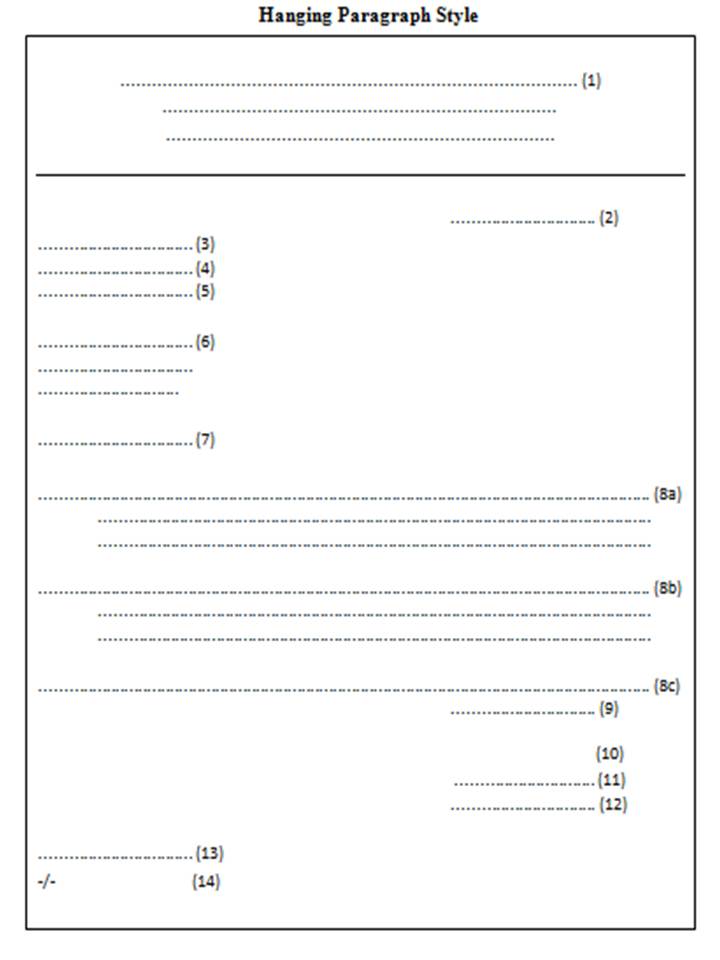
6. Hanging paragraph style
The shape of the letter hanging typing in the first line of each paragraph, typed on the left. Whereas later, for the next row enter five spaces until the paragraph changes. The Alinea Hanging (Hanging Paragraph) form is a letter in which the Letter Body has a hanging paragraph. The purpose of the hanging paragraph is after the new paragraph, the next line enters five spaces. So after the first paragraph, the next paragraph must be spaced around 5 spaces. Usually this form of letter is in certain service.


Part of business letter

Business letters are formal communication between paper, or business and are usually sent through the Post Office or sometimes by couriers. Business letters are sometimes called "mail" (as opposed to faster emails).

1.      Letter head
An identity that contains the logo, name, address and telephone of the sender of the letter.

2.      Reference
In an English letter usually containing the letter in front of the name of the executive who signed the letter, followed by a slash or a colon, then the name of the letter typer. Some companies add certain codes or numbers based on their archive system. Reference is placed at the top of the letter above date.
Example: Your ref: 22 March 2004
Our Ref: BS / KF

3.      Date
This is the part of the letter making date. While the writing format for the date is month / day / year, for example August 30, 2012.
a.      Example writing date using British Style
3 rd April 1990
British Style writing format is almost the same as writing in Indonesian, only on the date added by the suffix number. The date position on the British Style is placed on the right of the letter.
b.      Example writing date using American Style
April 03, 1990
Writing date using American Style is placed in the upper left of the letter in the format of Month Date, Year.

4.      Inside address
This section contains the name of the receipt of the letter, the office, and the name of the company accompanied by the address. If you are not sure who (name) the letter is intended, do not empty it, but try to use its position, such as "Director of Human Resources". Give the distance between the date and the recipient.

5.      Salutation
In this section, the term used is "Dear Mr./Mrs./Ms. (last name of acceptance) ", for example" Dear Mr. Fathoni ". But if the recipient's name is not acknowledged, write the name of the department, for example "Dear Director of Department of Human Resources". Give the distance between the opening greeting and the contents.
For business partners who are familiar with each other, usually write with "Dear Sue". The use of punctuation marks on salutation using the British Style is written without punctuation (semicolons or commas) and in American Style using a colon.
Dear Mr. Krisman => example in British Style
Dear Mr. Krisman: => example in American Style

6.      Subject line
Regarding making the recipient of the letter easier to find the purpose of the letter, such as Invitation, Apology, and so forth. This is an optional part of the business letter, meaning that we can include it or not.
a.      Writing the subject using British Style: The subject is placed between salutation and the contents of the letter.
b.      Writing subject using American Style: Subject is placed above salutation.

7.      Body of letter
The contents of the letter is a place where you write down what you want to convey. Paragraph in the contents of the letter must use single space (single space) and without any separation between each paragraph. Give the distance between the end of the contents with the cover.

8.      Complimentary close
This section as a sign that your letter has been completed, usually ends with the writing "Sincerely", "Sincerely yours", "Thank you", and so on. Note, There is a comma at the end of the closing and only the first letter uses capital letters. Give 3-4 lines between the cover and the name, which will be used for the signature.
9.      Signature
This part is the author's signature, usually using black or blue ink.

10.  Enclosure
If a letter contains documents or attachments other than the letter, the author must display the number of attachments by using "Enclosure (number of attachments)", for example "Enclosure (6)".

11.  Carbon copy natation
This section is used to inform the recipient of the letter, that the letter is also sent to those who need to know the contents of the letter. CC is placed in the bottom left of the letter.
Example: CC: Finance Section


Reference :